
Sewage Treatment
STP Plant
An STP plant treats domestic sewage through preliminary, primary, biological and polishing stages so solids and contaminants can be separated from the water.
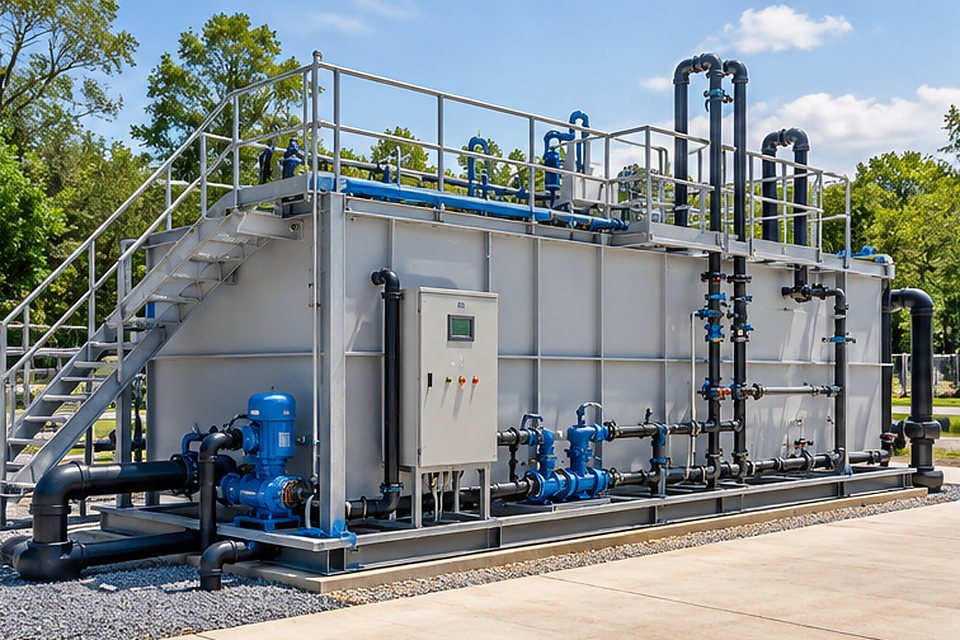
Stages of sewage treatment
Preliminary treatment
Screens remove rags, plastics and other coarse material, while grit separation protects pumps and downstream tanks.
Primary treatment
Settling or flotation separates solids that can be removed before the biological process.
Secondary treatment
Aerobic microorganisms reduce biodegradable material. Clarification or membrane separation then removes biological solids from the treated water.
Tertiary treatment
Filtration, adsorption, disinfection or membrane polishing is added where the required discharge or reuse quality calls for it.
Capacity and system formats
The supplied Pure Waters reference presents STP systems from 5 KLD to 100 MLD. The plant may use civil structures, prefabricated tanks, packaged equipment or a combination selected for the site.
Compact plants can reduce the construction area, but they still need maintenance access, sludge handling and reliable utility connections.
Biological process options
- Extended aeration
- Moving Bed Biofilm Reactor (MBBR)
- Sequencing Batch Reactor (SBR)
- Submerged Aeration Fixed Film (SAFF)
- Fluidized Aerobic Bioreactor (FAB)
- Membrane Bioreactor (MBR)
Applications
- Residential developments and apartment communities
- Commercial buildings and hotels
- Hospitals and institutions
- Industrial sites with domestic sewage streams
- Construction camps and distributed facilities
- Existing plant upgrades and capacity additions
Operation and maintenance
Stable operation depends on regular inspection of pumps, blowers, screens, biological reactors, clarifiers and disinfection equipment. Flow, dissolved oxygen, sludge condition and treated-water quality are monitored so corrective actions can be taken.
Discuss your stp plant requirement
Share the water source, flow, treatment objective and site conditions with Pure Waters.